REVIEW
HYPERPOLITICS: Extreme Politicization Without Political Consequences
by Anton Jäger
Verso Books, 2026
Watchdog no. 172 (August 2026)
In the (Northern Hemisphere) summer of 2020, in the USA, a staggering 26 million people—almost a tenth of the population of the United States—took to the streets under the banner of the Black Lives Matter (BLM) movement to rebuke the long-running trend of police brutality in that country. The turnout was the largest in US history. Calls to defund the police—once considered an extreme radical demand—achieved mainstream relevance for the first time. Change was in the air. Having witnessed the enormous outcry in the streets, US congressional Democrats introduced the George Floyd Justice in Policing Act in February 2021.
Eight months later, the New York Times reported2 that many of the police departments whose budgets had been cut after the BLM protests saw their previous budgets restored or even increased. In the years since, police brutality has continued to rise. What explains the disconnect between the enormous success of these demonstrations on the one hand, and the almost complete lack of material outcomes to popular demands on the other? According to Anton Jäger, this disconnect is exemplary of the modern political moment, which he calls Hyperpolitics.3
I had the thrilling experience recently of suggesting Jäger’s new book for acquisition by Christchurch City Libraries and having my request granted, making me (perhaps) among the first in New Zealand to read it. It is a nice piece of analysis, interesting for its contextualising of some significant political trends across wealthy societies, and useful for offering a framework for understanding the present moment and paths forward.
Jäger’s model frames the present moment against the backdrop of the last century or so of politics in many industrialised and post-industrial societies.4 It is a function of the relative proportions of two variables—politicisation (an index of political mobilisation) and institutionalisation (civic engagement, understood as affiliation and organisational membership).
Tracking these across time allows insights into the politics as it is experienced across the various eras in living memory, and explains much of the “vibe” of the present day—the most noteworthy and frustrating aspects of which are given away by the subtitle: “Extreme Politicization Without Political Consequences”. In the current moment, no matter how much proverbial spaghetti our mass movements throw at the wall in the form of political demands, none of it seems to stick. Jäger’s book explores the question: What explains the ineffectiveness of our movements’ demands—even the most popular ones—today?
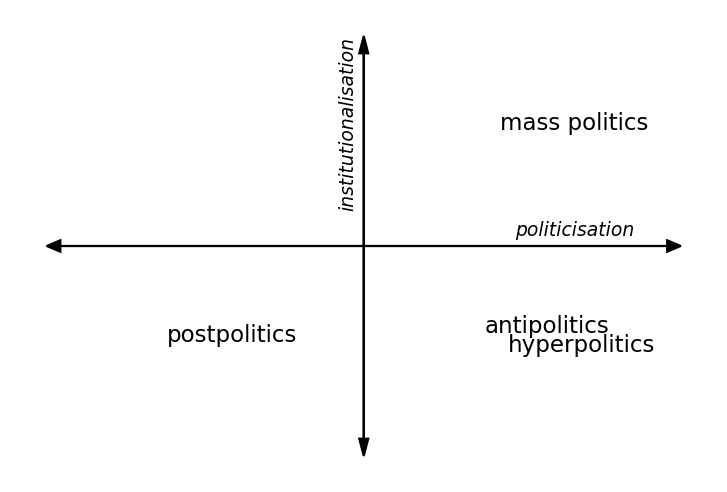
Imagine a Cartesian plane5 characterised by politicisation on the horizontal (x) axis and institutionalisation on the vertical (y) axis. A political moment can be understood as existing in one of four quadrants in this two-dimensional space—i.e., relatively high or relatively low in each of the two variables (Figure 1).
Tracking the evolution of each of these two metrics over the last few generations, Jäger presents a simple plot with highs and lows throughout the 20th Century and into the present (Figure 2).
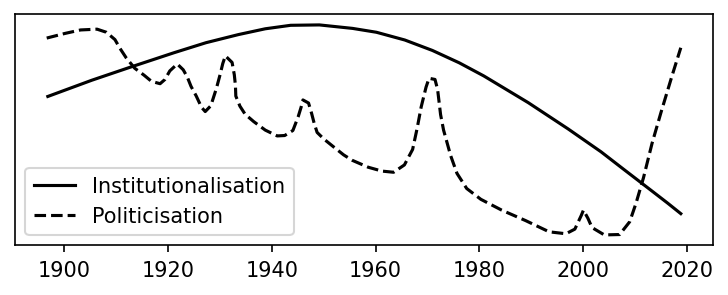
Jager acknowledges the construction of these trends as necessarily imprecise—more of “an intuitive diagram, synthesising fragments of existing graphs—of trade union density, incidence of political assassinations, size and frequency of demonstrations”6. Reasonable people can quibble over the appropriate slopes, convexities and discontinuities for New Zealand trends.
Four quadrants can be defined based on the interplay of politicisation and institutionalisation. The eras discussed in the remainder of Jäger’s book occupy three: mass politics (upper-right quadrant in Figure 1), postpolitics (lower-left), antipolitics, and hyperpolitics (both lower-right). These are discussed in turn below.
“Mass politics” (top-right quadrant in Figure 1), reigning during the “short twentieth century” (1914 to 1989, give or take), was “a world in which society [was] both highly socialised and politicised, populated by movements with clearly identifiable social bases and ideologies”.7 The gains of the era of mass politics were driven by a few spikes in mobilisation (e.g. the “wild” mass-political peak of the 1930s) and solidified into more “embedded” mass-political periods, such as the post-war years, when the economic boom “temper[ed] militancy and encourage[d] a newfound emphasis on the consumer household”. Notwithstanding the ebbs and flows of mobilisation during these periods, and the never-ceasing, creeping incursion of the market into all domains of life, both politicisation and institutionalisation nevertheless remained relatively high during this period, and institutions provided access to material support for the working class broadly.
The “postpolitics” of the “very long 1990s” (1989-2008) (lower-left quadrant in Figure 1) were marked by reduced levels of both politicisation and civic involvement. Francis Fukuyama declared “the end of history,”8 Margaret Thatcher announced that “there is no alternative” to capitalism,9 and Fred Durst told us to “give me something to break.”10 (The photograph by Wolfgang Tillmans adorning the book cover depicts a woman in a club, ostensibly emblematic of the individualistic spirit of the times). For the first time in at least several generations, for many people, “private lives were separated from public affairs.”11 It was a world “both depoliticized and desocialized, in which citizens retreat[ed] from collective life”.12 Despite a brief and modest uptick in mobilisation during the anti-globalisation movement, this was a time that exhibited a distinctive failure to apply sustained political pressure and effect meaningful change.
Jäger contends that the mass movements’ general inability in recent years to enact meaningful political change is a consequence of low institutionalisation. The reasons for this decline are multifaceted. Some of the more prominent threads are identified in the aforementioned Bowling Alone by Robert Putnam,13 which explores the decline in community in the USA. Low institutionalisation has, of course, been intentionally driven by corporate union-busting and sociological reasons such as reduced religious participation. But there are materialist mechanisms at work, too:
[By] the 2010s … Netflix, drugs, and delivery services ha[d] turned the twenty-first-century home into a self-enclosed repository of creature comforts. “Sitting at home alone has become a lot less boring,” the journalist Matthew Yglesias wrote14 … the ability to “stream alone” has driven up the “opportunity costs” of other activities. From a Marxist perspective, the constant refinement of personal consumption, like the attenuation of civil society, appeared as an imperative of capital itself. Collective life had to be thinned out to clear new inroads for the market.15
The GFC brought the apathy of the post-political era to an end, ushering in antipolitics. Politicisation increased apace through the 2010s and beyond: The Tea Party movement in the USA; the Occupy Wall Street movement; Podemos; Syriza; Indignados, more: Jäger discusses a range of manifestations of popular disenchantment with status-quo neoliberal politics exemplified by the bailouts of bankers and governments’ failures to guarantee a dignified life for the majority of workers. The “antipolitics” era was situated on the lower-left quadrant of Figure 1: high in politicisation and low in institutionalisation. It was characterised mainly, as the name implies, by reaction: less for a coherent set of ideological demands as represented by the major political parties, unions, and religious institutions that held sway over public life in the times of mass politics, and more against the general dysfunction and moral destitution that characterise modern politics.16 As the rage of the subaltern and disenchanted middle classes steadily grew, burgeoning and/or ephemeral movements searched (mostly in vain) for places to grab hold of what power could be seized. Alas, the long slow decline in institutionalisation cannot be repaired overnight.
Hyperpolitics is the cursed era in which we currently find ourselves. It is situated in the same quadrant as antipolitics, but warrants its own label. Hyperpolitics is a hellscape of chaos, the inevitable culmination of decades of erosion of social cohesion combined with ever-shortening attention spans of the Internet age. There are threads of optimism to be found when tracing the multiplicity of antipolitics’ scrappy attempts at reclaiming some semblance of public control, and the wobbly-legged beginnings of re-institutionalisation—“helter-skelter ebullience,” as Jäger described the Occupy gatherings. But such efforts were inherently fragile, doomed to fail more often than they succeeded. It is the manic-depressive reaction of our younger movements coming to terms with this that constitutes hyperpolitics:
"[I]deological disorientation is a hallmark of the hyperpolitical age. Debate erupts over one issue today, another tomorrow. But individuals no longer possess a heuristic17 capable of unifying and imposing coherence on their various viewpoints.18
…
If antipolitics was initiated by social groups hit hard by the crisis of 2008, now the entirety of the public sphere is politicized. By the same token, while populism attached itself to a recognizable ideological vector, hyperpolitics is a permanently volatile, diffuse phenomenon. Whereas populist parties at least made the first steps towards reinstitutionalization, “hyperpolitical” refers to a general atmosphere rather than to specific actors. In this respect, hyperpolitics represents a redoubling of antipolitics, a mode of viral panic typical of the Internet age with its short cycles of hype and outrage.19
A bird’s-eye analysis like this is satisfying insofar as it elucidates a path we have walked. There remains the question of where we should go—or more importantly (as I suspect many Watchdog readers can agree in broad strokes on direction), how do we get there?
Astute readers will by now have guessed at Jäger’s conclusion: “It’s the institutionalisation, stupid!” What is needed now more than ever in our atomised, individualised culture is a revitalising of social bonds. If the diagnosis of Bowling Alone is bleak, at least the solutions are straightforward. The single best step you can take to save the world, dear reader, is to do something with other people. Join a club! Subscribe as a dues-paying member of an organisation.20 Embrace prefigurative politics,21 the understanding that our means and ends must be aligned. The liberating, invigorating upshot of the institutionalisation-focused analysis is that we need simply focus on rebuilding community: the form or focus of involvement is less important than the necessity of building community per se. In a real sense, bowling leagues are just as important as political organisations.
Promising strands for recreational solidarity are plentiful, as exemplified by DIY culture (raves and the “free party” scene; punk and grindcore music and similarly-inspired subcultures). Beyond mere “consumption” or financial support of artists and performers, we should also aspire to engage in music and live culture via tangible commitments and active participation: playing, singing, dancing, painting, organising, promoting. (Speaking as a USAmerican and ten-year denizen of Aotearoa, I know the DIY ethos here is alive and well). The vitality of physical space is also central to healthy live culture; we need to safeguard and expand shared spaces. In Ōtautahi Christchurch, music venues have been a scene of struggle in recent years, with new and renewed contention over loudness, zoning, and developers’ obligations vis-à-vis noise insulation. The grassroots scene has responded admirably, with independent venues such as the Darkroom taking leading roles in the drafting of Plan Change 21.22
Sport has often been seen as a “refuge” from politics, but this is not an uncontestable law of the universe, either. Anti-fascist football culture is a thing.23 There are signs that in our lifetime even the famously-apolitical USA sporting culture may yet evolve to something more hopeful.24 (Imagine what could happen if millions of USAmerican football fans learned what their compatriots in Green Bay, Wisconsin already know—that public ownership of the local professional American football team is practical, fun, and economical, as well as a powerful vehicle for solidarity?)25 Here again, New Zealand’s love of sport bodes well for maintaining and strengthening bonds of solidarity; one in four New Zealanders are members of a sports club.26
Hyperpolitics is an enlightening romp through decades of rich-world politics. Its thesis is sound. I would have enjoyed a bit more time spent on a few items that seem important in the current moment, even if only tentative or speculative.
As mentioned earlier, the author didn’t explicitly state the focus of his analysis, although it became clear soon enough: This book focuses mainly on the rich countries, especially (not to say exclusively) the Anglosphere. Consequently, the all-encompassing dynamic of imperialism was elided almost entirely. It may be that this could have been fairly considered outside the scope of the book, but it is a pity, since a global perspective is perhaps the only unifying narrative thread that could tie together the disillusionment and atomisation of the (supposedly) comfortable-but-lonely masses of the rich world with the never-ceasing march of capital accumulation and consequent alienation. Jäger had nothing to say about anti-war movements in the USA, for example; few would dispute that their success or failure in our lifetime will determine the future of the Left in wealthy countries, not to mention the economic terms of engagement between countries in the imperial core and the periphery. Similarly, at this political moment, it is odd that the Palestinian liberation movement was not identified as a promising focal point for the ostensibly-diffuse energy that is searching for leverage in the hyperpolitical present.
One of the most memorable passages in Hyperpolitics included a lengthy excerpt from Eric Hobsbawm’s memoir Interesting Times which exemplifies the “immersive character of political belonging, including the passions it once aroused”27 and the vitality of those passions in the creation and persistence of bonds of solidarity:
Next to sex, the activity combining bodily experience and intense emotion to the highest degree is the participation in a mass demonstration at a time of great public exaltation. … it is by its nature collective … and [entails] physical action—marching, chanting slogans, singing—through which the merger of the individual in the mass, which is the essence of the collective experience, finds expression. The occasion [of “the last legal demonstration” of the Communist Party of Germany in 1933, the subject of Hobsbawm’s reflection here] has remained unforgettable, although I can recall no details of this demonstration…
Jäger pontificates on the absence of anything resembling a similarly-powerful visceral exercise in solidarity in the shared memory of today’s young and middle-aged. He worries that there may be precious few or no analogues to the enormity of the disciplined-yet-revelatory exuberance of the heyday of mass political demonstrations of yore. Certainly, there are the beginnings of a rebirth, as Jäger acknowledges. But he seems to believe that the increasing fragmentation of the workplace, and an insufficiently-disciplined approach to Left mobilisations, leaves no avenues for exercising solidarity and building power except the routine social interactions of the sphere of social reproduction and care work: “In an era of precarious employment and working from home, many no longer interact with coworkers in person on a daily basis, one still has to drop their children at daycare, attend parent-teacher meetings, or visit their own parents in retirement homes.”28
Of course, these remaining opportunities for connection in the day-to-day are critical. But, as I discussed above, I see no lack of opportunity for building political solidarity via crowds engaged in collective joy. We homo sapiens have been at it a long time. See also the late great Barbara Ehrenreich’s delightful Dancing In The Streets: A History Of Collective Joy.29 Even in these dreary times, human beings still like to party—as Jäger’s description of the postpolitical period demonstrated. And whereas the oft-cited hedonism of the “long 1990s” is frequently dismissed as escapist, there is no reason that it need always and only be so. There is still potential for live culture to serve as a jumping-off point for political re-institutionalisation.
Overall, Hyperpolitics was an enjoyable and insightful read. As may be inferred from my remarks on music and sport, I retain an abiding faith in the possibilities for a better world, and in the power of creative communities to wrest back control of our shared lives from the owning classes. The thesis of Jäger’s Hyperpolitics is vital, and the path forward is clear. We live in a time of decayed community and institutional bonds, and we need to rebuild them. Fortunately, collectivity is fun.
Kevin is the Watchdog Web Editor.↩︎
J. David Goodman, “A Year After ‘Defund,’ Police Departments Get Their Money Back,” New York Times, 10/10/21: https://www.nytimes.com/2021/10/10/us/dallas-police-defund.html↩︎
Jäger, Anton (2026). "Hyperpolitics: Extreme Politicisation Without Political Consequences", London, Verso Books. https://www.versobooks.com/products/3460-hyperpolitics↩︎
He doesn’t explicitly signal as much, but it is clear Jäger’s narrative centres mainly on the USA and Canada, Europe, and Australia and New Zealand by association.↩︎
A Cartesian plane is a two-dimensional grid formed by two perpendicular number lines: the horizontal x-axis and the vertical y-axis. They intersect at the origin (0,0). It allows you to pinpoint any exact location using an ordered pair of coordinates (x, y). -Ed.↩︎
Jäger, p. 6↩︎
Ibid., p. 6↩︎
https://en.wikipedia.org/wiki/The_End_of_History_and_the_Last_Man↩︎
Limp Bizkit, “Break Stuff” (official music video). https://www.youtube.com/watch?v=ZpUYjpKg9KY↩︎
Jäger, p. 4.↩︎
Ibid., p. 5.↩︎
Putnam, Robert D. (2000). Bowling Alone: The Collapse And Revival Of American Community, Simon & Schuster. https://www.simonandschuster.com/books/Bowling-Alone-Revised-and-Updated/Robert-D-Putnam/9781982130848
The book inspired a Netflix documentary, “Join Or Die” (https://www.imdb.com/title/tt26081864/).↩︎
https://www.slowboring.com/p/sitting-at-home-alone-has-become↩︎
Jäger, p. 29.↩︎
To be sure, individual movements, such as the Tea Party, had more or less articulated views, but the antipolitical era had less coherence overall than the large-scale institutional and party-driven mass politics of the past.↩︎
A heuristic is a mental shortcut or “rule of thumb” used to solve problems or make decisions quickly. -Ed.↩︎
Jäger, p. 33.↩︎
Ibid., p. 75.↩︎
CAFCA, for instance. https://www.cafca.org.nz/join-cafca/↩︎
Sinead Gill: “Punk’s Not Dead (It Just Needs A Buffer Zone): Councillors Refuse To Turn The Volume Down On CBD.” Press, 13/5/26. https://www.thepress.co.nz/nz-news/361003422/punks-not-dead-it-just-needs-buffer-zone-councillors-refuse-turn-volume-down-cbd↩︎
Sam Wetherell, “The Ref’s A Tory.” Jacobin, 1/9/16. https://jacobin.com/2016/09/clapton-ultras-football-clubs-west-ham-politics.↩︎
Allie Conti, “It’s an Anti-Fascist Thing: How An Obscure German Soccer Team Gained A Brooklyn Cult.” New York Times, 7/2/19. https://www.nytimes.com/2019/02/07/nyregion/fc-st-pauli-east-river-bar.html.↩︎
The Green Bay Packers is the only publicly-owned team in the USA’s National Football League (NFL). https://prospect.org/2026/02/12/feb-2026-magazine-sports-green-bay-packers-nonprofit-community-owned/↩︎
Active NZ Participation Trends: The New Zealand Participation Survey, 2017-2023. July 2024. https://sportnz.org.nz/media/lupchbdk/active-nz-participation-trends-2017-2023_july-2024.pdf↩︎
Jäger, pp.87-88↩︎
Ibid., p. 92.↩︎
2006, Metropolitan Books: https://us.macmillan.com/books/9780805057249/dancinginthestreets/.↩︎
Watchdog 172 -- August 2026
Non-Members:
It takes a lot of work to compile and write the material presented on these pages. If you value the information, please send a donation to the address below to help us continue the work.
Foreign Control Watchdog, PO Box 2258, Christchurch, New Zealand/Aotearoa.
Email