NEW ZEALAND AND THE GLOBAL IMPERIAL SYSTEM
- Josephine Varghese
Josephine is an organiser for the Palestine Solidarity Network of Aotearoa (PSNA) and a lecturer/academic at the University of Canterbury. Her research, teaching and activism focus on imperialism, inequality, labour and migration.
Introduction
Tēnā koutou katoa dear comrades. I'm honoured to be invited to speak with you! I commend you on 50 years of work and I hope that we can take it forward. I will start my talk with a snippet from a chat I had with Murray Horton some weeks ago. I said, "Murray, my goal is to destroy the US empire". Murray then responded to me saying, "in that case the NZSIS will definitely have a file about you". He also asked me if I was a citizen of NZ yet, and I said, "no, a permanent resident". "Be careful".
I'm not sure I've taken that advice, not because I don't understand that what he's saying is true, and that there are major challenges before us in this mission, but because each day as I live within this imperial system, my resolve gets more and more hardened. I get more and more convinced that there is indeed no other way than to fight this empire, which profits from war, which profits from genocide, which profits from environmental destruction.
It profits from disease and human suffering. In the United States, 100,000 people have been dying every year since 2021 in the opioid crisis, which has been foisted upon them by the pharma industry, and it got so bad because they don't have healthcare, they don't have addiction services, they don't have affordable housing and they don't have mental health services either. So, people are dying on the streets in the nation that is the head of the global imperial system.
Why am I interested in anti-imperialist theory and praxis? It goes back to my own journey of what really radicalised me. I grew up in neoliberal India. The India after the IMF reforms. The Soviet Union had collapsed, and India no longer had that all-weather partner. So then comes in the International Monetary Fund. They can give you loans, they can give you money, but in return, the nations concerned need to deregulate their labour markets, cut down their welfare schemes (austerity), and they need to open up their assets and resources for foreign investment.
So, this started happening in the early 90s and I grew up in that India. The kind of knowledge that we are getting in India in that context is coming from the West. We are being taught that there is only one model - that is the Western model of development. And we just need to become more and more like the West. And that's how we solve our problems in India. The problems in India are because we are not Western enough, and we just need to emulate the Western model.
And then, in 2014, I arrived in Christchurch for my PhD, and I am walking through the streets of Christchurch city, and I am seeing homelessness here. And I see that the homeless people are mostly brown people. And at that time, I was culturally progressive but economically a liberal - as I was raised in that neoliberal knowledge system. But then, each day that I lived here in Aotearoa New Zealand, in winter, in the cold, mouldy student flat, surrounded by struggling students barely making ends meet, learning about child poverty and mass incarceration of Māori, I realised that the Western model of development is just a façade, which started crumbling before my eyes.
NZ Child Poverty
Currently, one in eight children in Aotearoa New Zealand are living in poverty. One in four Māori kids, one in three Pasifika kids. So, this whole idea of the success of the Western model of development started to crumble before my eyes. Then I started rethinking about India. What happened to India? It's really interesting, because in India we had efforts to address the underdevelopment caused by colonisation. I am from Kerala; this is a communist state - the only state in India that is currently being governed by communists. And Kerala is the only state in India that has eliminated extreme poverty.
And then I studied more about Aotearoa New Zealand, and I understood that it became a better country with robust public services not through the Western capitalist model of development, but through people like you fighting against that model and guaranteeing workers' rights. It was the anti-capitalist movement here that created prosperity. That created a middle-class society in New Zealand, in Australia, in Europe and so forth. Before that, inequality was dizzyingly high.
So, what is standing in our way in the global South is not that we have to become more Western. Actually, what is standing in our way is the global imperial system that imposes privatisation, austerity and labour deregulation in our countries for the profits of the global ruling class, and at the head of the current global imperial system is the United States, and this is why my goal is to destroy the US empire.
To quote Che Guevara: "While envisaging the destruction of imperialism, it is necessary to identify its head, which is no other than the United States of America". Speaking of Che, I would like to share the delightful news that I have been accepted to present a paper on imperialism at the 60th anniversary of the Tricontinental Conference at the University of Havana in Cuba in January 2026, which was organised by the likes of Castro and Che, and attended by anti-imperialist stalwarts and leaders like Salvador Allende, Cheddi Jagan and others from the tricontinental region (Asia - Africa - Latin America).
Presentation Structure
This presentation is structured like this:
- Part 1: Introducing the concept of the global imperial system
- Part 2: Looking at how New Zealand is integrated into the global imperial system
Part 1: An Introduction To The Imperial System
1.1. Why Is Studying Imperialism Important?
Primarily, why I am interested in researching imperialism and engaging in activism on imperialism with people like John Minto, Joseph Bray and all of you is because we cannot understand local politics without understanding the global context. I am fed up with decontextualised, racist understandings of the world. If you ask people why there is poverty in Africa, they will say "Africa is corrupt, it's backward, primitive/uncivilised". "There are no good leaders there", and so forth. This is such a decontextualised understanding. It does not account for the context in which Africa became impoverished, and what its challenges are, in achieving sovereignty, liberation and development. And this is fundamentally the reason why I am interested in the study and praxis of anti-imperialism.
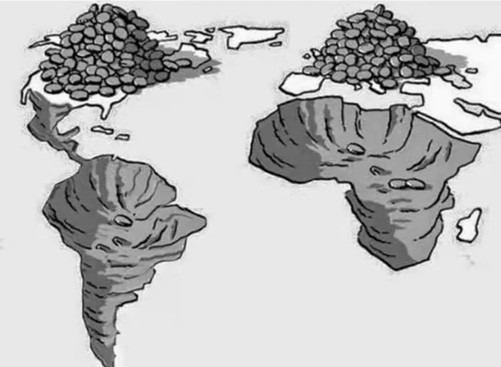
Imperial wealth extraction. Cartoon by polyp
In this image you can see that South America and Africa are mined out and all that wealth is sitting in North America and Europe. It is important to remember that even that wealth is not used for everyone in those nations. It is concentrated at the top. It's not with the working class. I just mentioned how 100,000 people are dying every year in America in the opioid crisis. In the UK, there are riots happening, anti-immigrant riots - but these riots are fundamentally linked to the impoverishment of the British working class. So, all that wealth that they stole from India, they still fail to address the basic problems in their society. Just another example of the failure of the Western model of development.
1.2. Structure vs Agency Debate - Why A Structural Approach Is Necessary
I would like to introduce you to the Structure vs Agency debate-this is an ongoing debate within social sciences and politics for many decades. People who are interested in structure look at things like imperialism, capitalism, the economic system, the structure of the state and so on. Agency focuses on individual analyses - what individuals and nations, for instance, can do individually, often without contextualising it within the larger structures that nations and individuals are embedded in.
In my observation, under the global capitalist system, there is a huge focus on agency, and not enough focus on structures. A good example is, under neoliberalism, poverty is explained as an individual failure. Isn't it? They do not look at the structures which cause it. But if we look at the structures, it will become clear that poverty is part of the very design of the capitalist system. Because of this disproportionate focus on agency, I am interested in focusing instead on structure - which can help us explain social patterns - both locally and globally.
Empire Overthrows Or Kills Opponents
Let me show you how structure works from a geopolitical perspective. Actually, I learned about this particular example from a PSNA rally where Murray Horton spoke. I was aware of this happening in the global South; I wasn't aware that this happened in Australia. Gough Whitlam, a former Prime Minister of Australia, got removed in a coup sponsored by the US and British intelligence in the year 1975, because he wanted to carve out an independent foreign policy for Australia. He wasn't a radical Leftist or anything - just a moderate. But he wanted Australia to have a foreign policy independent of the empire. Do you see the tension between structure and agency here? And if we don't know what the "structure" is and how it operates, we won't really understand what is going on. This is one example.
Gough Whitlam was quite lucky that he wasn't African or Asian, because if he was an anticolonial leader in Congo, like Patrice Lumumba, who was publicly beaten, tortured and publicly executed, and they didn't stop there. They dissolved his body in acid and they returned one of his teeth as a trophy back to Belgium. The CIA and Belgian intelligence were making an example out of Patrice Lumumba - an excellent leader who proposed the nationalisation of Congo's resources which were until then being looted by colonial powers. They were not ready to let go of economic and geopolitical control. Inconvenient leaders - some of the most impressive revolutionaries and leaders in the world, like Lumumba of Congo, like Sankara of Burkina Faso, like Mossadegh of Iran, are assassinated, imprisoned, removed in coups, or invasions.
So, when we think about the current genocide in Congo, for instance, we must think back to what Belgium and allied imperial nations did to continually destabilise, impoverish and loot Congo. And what they did to Lumumba was after Belgium committed one of the most brutal genocides in human history. Around ten million Congolese people were killed - thousands mutilated. Yet when an anticolonial leader emerged who wanted to do better for his people, the global imperial system ensured to make an example of him. I highly recommend the book "How Europe Underdeveloped Africa" by Walter Rodney to understand how through colonialism and neocolonialism Europe systematically underdeveloped and impoverished Africa.
Whether it is Lumumba, Sankara, Mossadegh or Allende - the common denominator in their removal is the CIA, the head of the imperial system. On September 11, 1973, Pinochet's army carried out a US-backed coup unseating Allende. Allende used a rifle gifted by Fidel Castro to take his own life. This is the September 11 that I prefer to remember. And despite all this history and events, New Zealand joined the Five Eyes in 1955 and remains a member of this imperial spy network to this day.
1.3. Imperialism Theory: The Imperial System By Claudio Katz (2022)
Claudio Katz is an Argentine political economist and is a key theorist within the area of imperialism in the 21st Century. Katz proposes that while imperialism is linked to capitalism, these are not one and the same. So, what is the link between imperialism and capitalism? Capitalism is the prevailing mode of production, but imperialism is slightly different. It is the system/network and set of processes which enforces capitalism across the world.
So, what are these processes? Interconnected systems, processes, institutions (e.g., the US military with over 750 bases across the world), currently dominated by the US (although waning in power). So, if you think about China, China is not interested in enforcing capitalism across the world. In fact, it is an ally of the non-capitalist nations in the world like North Korea, Cuba and so forth.
The imperial system that Katz identifies will not allow an alternative to capitalism to come up anywhere in the world. The imperial powers do not allow nations and peoples across the world to exercise sovereignty over their resources and labour. Instead, it ensures that the resources and labour of the world (especially in the peripheral nations - in the global South) remain open to privatisation by the global capitalist class largely headquartered in the imperial core.
The imperial system is not only a military network (we are familiar with the military network). It is a financial network (e.g., IMF, World Bank), trade (World Trade Organisation), information and media (e.g., Reuters, AFP, AP). These news wiring agencies have a history of supporting empire. They operated as a cartel during the European colonial period. This imperial network coerces nations across the world to adopt neoliberalism - in the turn to neoliberalism of Russia, India and China, the imperial system played an important role.
Currently, the USA is deploying aircraft carriers in the Caribbean Sea. I am going to Havana in January 2026 and I'm seeing this military theatre being built up off the coast of Venezuela and in that region near Cuba. The question is - who controls this military network - the largest in the history of humanity? Do you think it is democratically controlled? If not, who controls it?
Audience member: America But, who in America? Do you think it is democratically controlled? Audience Member: No Audience Member: Controlled by the elite. Yes, the elite. More specifically, the military industrial complex and the various lobbies, like the oil lobby. The lobby that wants Venezuela's oil, who cannot stand that Venezuela nationalised its vast reserves of oil. The lobbies that want lithium from Bolivia and therefore did a coup against its first indigenous President, Evo Morales who wanted to nationalise Bolivia's lithium for the benefit of its impoverished people. Elon Musk wants lithium, cobalt and so on. Destabilising countries allows for cheap extraction.
1.4. The Middle East And The Global Imperial System
Look at the Middle East; there are 30 US military bases around Iran. Iran and Houthi-controlled Yemen are the only sovereign nations in that region (and this is evident by the fact that these are the only two nations supporting the Palestinian resistance). All other nations are colonised by US military bases. Just recently there were reports that the UAE is buying land in Israel. What the global imperial system has done is it has eliminated all the threats against them (through coups, invasions, sanctions) and promoted a comprador class - people who support their interests across the world. This is the reason why Iran is vilified (because they have not bowed down to the empire). And this is why I was horrified when the Green Party demanded sanctions on Israel's and USA's number one target state in the region, Iran, who support the resistance in Palestine.
The net favourability of Israel is at historic lows in Western nations. But still the genocide is ongoing. Despite having no democratic or popular support. It shows that the global imperial system is not democratic. It uses the façade of democracy to further the interests of the wealthy capitalist class. The genocide is ongoing because it is profitable for them. UN Special Rapporteur Francesca Albanese's report details this and names the corporations that profit from genocide. Some examples include Palantir Technologies, arms corporations, Blackrock, Rocket Lab, NIOA and so on.
Why does the US empire support Israel so much? And why does it oppose vehemently Palestinian, Iranian, Cuban and Venezuelan sovereignty? And despite being the biggest violator of sovereignty in the world, it is somehow interested in separation of Tibet, Taiwan, Hong Kong, Ukrainian ethno-nationalism? Why is USA so interested in blocking the sovereignty of Palestine? Audience member: Resources!
Yes, absolutely - and theories of imperialism go deeper. The core-periphery model and the global systems model divide the world into three categories: the core (advanced Western nations), the periphery (developing nations in the global South) and the semi-periphery (nations which exhibit some characteristics of both). This structure of the world is maintained to allow the cheap extraction of resources and labour from the periphery to the core. Nations achieving true sovereignty goes against continued cheap extraction of the periphery. If Palestine becomes sovereign, then the US empire loses control over that strategically crucial part of the world.
Part 2: New Zealand And The Imperial System
2.1. Introduction: New Zealand's Position in the Imperial System
I work at the University of Canterbury and there is an organisation called the New Zealand Institute of International Affairs. This group always invites representatives of, or aligned to, the US empire to talk at the University of Canterbury. A few months ago, they invited the Chargé d'affaires of the US Embassy (number two in the US Embassy in NZ) to speak. Me and some colleagues went to the talk to challenge him.
Do you think New Zealand is part of the imperial core or periphery? Audience member: Core! Do you think everyone in New Zealand is part of/benefits from this status? Audience member: No! Yes, I have many Māori socialist friends who identify more with the global South than the core. They don't think Māori have been made part of or benefit from the dominant system here. So, they want to have better ties with China and the anti-imperialist part of the global South.
The core is very class based - imperialism benefits the ruling class, while destroying the planet and exploiting labour of the working class both at the core and the periphery, but more so in the periphery. New Zealand's recent foreign policy decisions indicate its closeness to the core. PM Luxon, for instance, sent six military personnel to the Red Sea to monitor the Houthis on behalf of the ships passing through (use of public office for private benefit of the contractors).
2.2. How Can We Understand NZ's Integration With The Empire?
- Military links: Five Eyes, FBI, intelligence, corporate links, for instance Rocket Lab
- Economics (follows the models and orthodoxies of the empire e.g.: neoliberalism, ongoing loot of the global South)
- Political: "nations with shared values"
- Knowledge/Media: the system of knowledge we subscribe to in NZ is part of the imperial knowledge system. For instance, the "knowledge" that Western systems are superior and other regions suffer due to their backwardness/primitiveness/lack of merit rather than because of imperialism.
In my view, the nature of racism has changed. It is no longer about biological characteristics like skin colour as much as it used to be. However, the belief that Western systems are just inherently better is an ongoing assumption deriving from the imperial narratives, media, curricula, and people. How did we get integrated into the global imperial system?
The original sin: the New Zealand Company - a company that offered land that didn't belong to them to investors. Like India was colonised first by the British East India Company, the New Zealand Company - a British transnational corporation was the first step in colonising Aotearoa. The company's board members included aristocrats, Members of Parliament and a prominent magazine publisher, who used their political connections to ceaselessly lobby the British government to achieve its aims. We can see here, the confluence of the interests of capital, political power and media power in making the colonisation of Aotearoa possible. And this is why CAFCA is so relevant. It is the campaign against foreign ownership of Aotearoa. How does this manifest in today's NZ?
2.3. Private Consultancies In New Zealand: "The Big Four"
I want to introduce you to some of the major consulting corporations, "the big four"-these are foreign corporations who have taken over the prime real estate in most of our cities. Deloitte, PwC, Ernst & Young and KPMG. But what do they do? Are they producing something? Are they manufacturing products that are useful for ordinary people? What do they do? Audience member: They're accountants! Audience member: They support neoliberalism!
And who are their clients? Their clients are the wealthiest people and corporations. Their clients are also various Government departments. This is the sad thing. Before I joined the University of Canterbury, I worked as a researcher at the School of Government at Victoria University of Wellington. We were looking at how big money undermined democracy in New Zealand. And we found three main ways this happened: one is political donations, the second is lobbying and the third is private consultancies.
So, when these private consultancies have huge Government contracts to provide policy advice, for instance, they will never provide advice that goes against the interests of their rich clients. In fact, they would use their leverage within the Government to further the interests of their big private clients. What is the result of this situation of big money's pressure on our democratic institutions?
2.4. Case Studies: BlackRock And NZ Steel
New Zealand's $2 Billion Deal With BlackRock
During the time of the previous Labour government, New Zealand signed a $2 billion deal on future energy infrastructure with BlackRock. BlackRock is the biggest asset-owning empire in the world. They profit from the privatisation of valuable public assets. They have huge investments in the war industry. In the genocide industry. And the Labour government, with Greens in it!! The Greens were part of this; in fact, James Shaw was in the room with Hipkins when they signed a deal with BlackRock which would jeopardise our ownership of Aotearoa New Zealand's future energy infrastructure.
NZ Steel: Corporate Welfare
Another example, NZ Steel was granted $140 million by the Government for transition to sustainable industrial processes. And New Zealand Steel is not a New Zealand corporation. They are owned by the likes of Citigroup, Goldman Sachs; even BlackRock has shares. And as part of my research, I investigated their previous year's profits. It was over $300 million. So, they could fund their own transition. And that would be the Government's approach to ordinary New Zealanders: "pick yourselves up by the bootstraps", "don't expect handouts".
Yet profitable foreign-owned corporations are not held to the same standard. The same year, Cyclone Gabrielle had happened. The Government could have used the Emission Trading Scheme funds to support some of our most marginalised communities affected by that climate disaster. Instead, the global imperial system-linked New Zealand government prioritises the interests of the wealthy over those of our own struggling people.
When our leaders like Ardern and Luxon visit the US, they will meet the President, but also CEOs of corporate empires like BlackRock. What has happened to our political Establishment? They can't claim ignorance about the conduct of BlackRock because not long before New Zealand signed the BlackRock deal, French protesters occupied the headquarters of BlackRock in Paris due to its links in pushing the French government to raise the retirement age there. Yet our Governments welcome them to New Zealand: "come and colonise us!".
Marx and Engels said this a long time ago: "The executive of the modern state is a glorified committee to manage the common affairs of the whole bourgeoisie". And this is so clear under neoliberalism. When Chris Hipkins took office as PM after Ardern resigned, do you know where his first engagement was? He did not go to the homeless shelter. He did not go to the food banks. He did not go to the unions. Instead, he travelled to Auckland and bent his knee before Simon Bridges at the Auckland Chamber of Business. That was his first engagement as a newly sworn in PM of this country. And all these PMs-Ardern, Hipkins, Luxon-appoint corporate lobbyists in high positions such as chief of staff and advisory roles in the beehive.
2.5. The Current Government's Policies
The current Coalition Government is encouraging rich foreign buyers to buy homes here and granting golden visas to the wealthy. The idea is that we need to invite foreign rich people here. But what do these rich people do? What are the politics of rich people? Is it in the interest of ordinary working-class New Zealanders to have these rich people here? Audience member: No
What kind of politics will they be supporting once they come here? They will be supporting lower taxes for the rich - shifting the tax burden on the workers. They will be supporting privatisation and profiteering from our public assets and primary services. The things that can give the most amount of profit - the services and products whose demands are inelastic (always in demand) - these are the most lucrative areas for the rich to invest in. So, healthcare, electricity/power, housing and so on. These services are already under pressure to be privatised following decades of deliberate underfunding. More rich people would mean more pressure for this project which strips us of our rights.
So, we don't want to invite the rich here. We must drive them out. There is a lot of fear mongering around rich people leaving. But let them leave! When they leave, they can't take our land, our water, our forests, our houses, our assets with them. This means the people can take control of these vital resources and use them to meet the needs of people and the planet (not the profits for a few)!
Audience member: Josephine for Prime Minister!
Conclusion
The pressure of the empire is felt across all our political, economic, and cultural spaces. For Aotearoa New Zealand to become sovereign, we will need to cut ties with the global imperial system. This is why I think anti-imperialist organising should be at the heart of all political activism in Aotearoa New Zealand. We need to expand public ownership, because the "public" or the "commons" is constituted by all the people in a nation - not a narrow wealthy class. The working-class form most of the population in Aotearoa and across the world. Workers require education, pensions, healthcare, public transport, power and connectivity. These basic services are threatened when they are privatised. The imperial system profits from the privatisation of public assets and key services.
So, We Must Seize Back And Keep Our Assets Public!
But to do that, we'll need to decouple from the global imperial system and become a sovereign state. Tino Rangatiratanga! Ka kite anō, kia ora!
Watchdog - 170 December 2025
Non-Members:It takes a lot
of work to compile and write the material presented on these pages - if
you value the information, please send a donation to the address below to
help us continue the work.
Foreign Control Watchdog, P O Box 2258, Christchurch, New Zealand/Aotearoa.
Email